Cinematic Introduction: Awakening Amidst the Mists of the Douro
It isn’t just the sun. It is the way the light—still timid and tinged with a mystical, almost bruised violet—filters through the tattered shreds of fog clinging to the schist terraces. It is six in the morning in the heart of the Douro Vinhateiro, and the silence is so profound you could swear you hear the sap rising through the ancient vines. Here, the air is not merely breathed; it is tasted. It smells of damp earth, resinous rockrose, and that electric promise that only mineral-rich soil can bestow after a nocturnal rain.
For the traveler who has exhausted the charms of Tuscany or the well-trodden paths of Bordeaux, Portugal reveals itself not as an alternative, but as the ultimate Mecca. Forget the postcard-perfect Algarve or the tram-riddled streets of Lisbon; the true Lusitanian spirit—that elusive saudade transformed into pure hedonism—resides in its wild, rugged interior. This is a territory of castles guarding bedroom secrets and wineries that are, in reality, cathedrals of contemporary design.
When you uncork a bottle in these lands, you aren’t just releasing fermented grapes; you are liberating centuries of geological resistance. This is a route for those who understand that luxury is not excess, but the exclusivity of silence and the perfection of a hand-blown crystal glass reflecting a sunset that looks as if it were painted by Turner. Welcome to the unknown Portugal, where wine is the Ariadne’s thread guiding us through a labyrinth of ancestral pleasures.

Context and Terroir: The Rebellion of Schist and the Soul of Granite
If the wine map of Portugal were a novel, the terroir would be its most complex and temperamental protagonist. To understand what we are drinking, we must first grasp that this country is a geological archipelago of insulting diversity. While the rest of the world obsesses over Cabernet or Chardonnay, Portugal has jealously guarded an arsenal of over 250 indigenous varieties, each adapted to a specific microclimate with the precision of a Swiss watchmaker.
The Douro is pure drama. Here, the vines do not grow; they survive. The schist soil—that laminar stone that crumbles like an old biscuit—forces the roots to descend up to 20 meters deep in search of a single drop of water. This hydric stress translates into a brutal phenolic concentration. The Touriga Nacional grape, the undisputed queen, provides a backbone of steel wrapped in violet petals—a duality that both confuses and enchants the palate.
As we move south toward the Dão, the landscape shifts drastically. Granite takes the lead. Here, the climate is cooler, shielded by the Estrela, Caramulo, and Nave mountain ranges. The result is wines of an aristocratic elegance, possessing a vibrant acidity that allows them to age for decades without losing their composure. The Dão is the Burgundy of Portugal—a sanctuary for lovers of subtlety.
And then there is the Alentejo, that infinite plain where time seems to have halted under the weight of the summer heat. But do not be fooled by the stillness. The soils here are a mosaic of clay, marble, and slate. The Alentejo is the laboratory of experimentation, where white grapes like Antão Vaz develop an almost buttery unctuousness, and the reds are explosions of black fruit and spice, as warm as the embrace of an old friend. To understand Luso terroir is to accept that the ground has a memory, and each sip is a narrative of climatic survival.

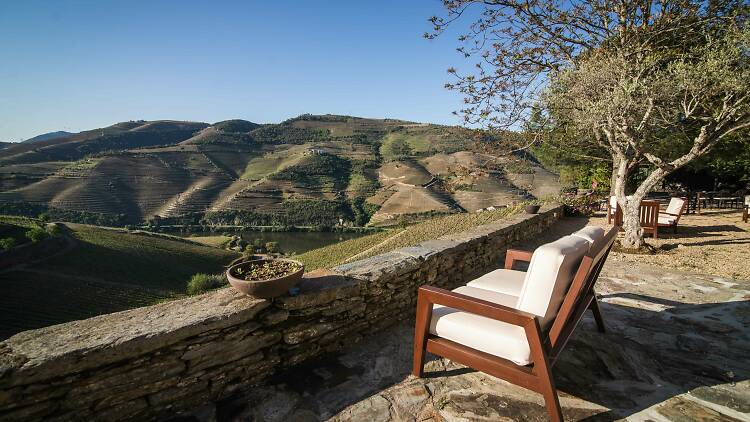


I. Quinta Nova de Nossa Senhora do Carmo: The Lookout of the Gods (Douro)
Architecture and Vibe
Arriving at Quinta Nova is an almost religious experience. Perched on the right bank of the river, this 18th-century estate has been transformed by the Amorim family into the epitome of rustic-chic luxury. The architecture respects Pombaline sobriety: whitewashed walls, red-tiled roofs, and a small chapel that stands sentinel over the vineyards. However, inside, the design is functional avant-garde, where noble woods and wrought iron create the atmosphere of a private club for connoisseurs.
The Wine Tourism Experience
Forget standard guided tours. Here, luxury is private. Imagine walking the stone paths through centenarian vines guided by the head viticulturist, only to descend into a tasting room suspended over the river. The sound of the cork popping is amplified by the acoustics of a room where light enters from above, illuminating the glasses like sacred chalices. The crown jewel is their “Wine Museum Center,” which chronicles the history of the Douro with a curation that would make the MoMA envious.
The Star Wine: Mirabilis Grande Reserva White
Tasting a vertical flight of Mirabilis is a sensory odyssey. This is no ordinary white; it is liquid velvet. On the nose, it unfolds notes of graphite, flint, and white fruit so pure it feels freshly plucked from Eden. On the palate, it presents an architectural structure of acidity and minerality, with a finish that evokes the dawn over the river. It is a wine that is not merely drunk; it is contemplated.
The Wow Factor
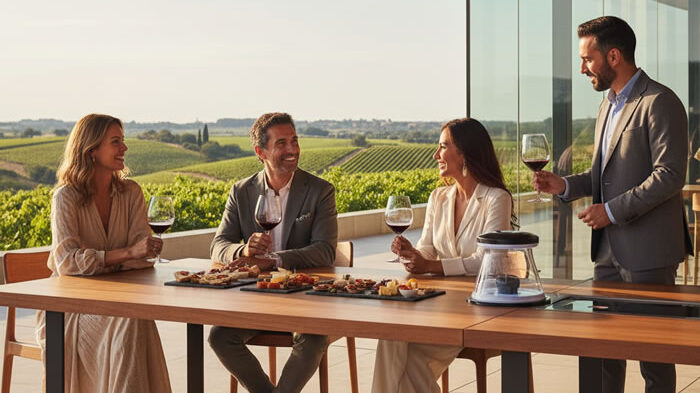
The “Patamar Wine Adventure”: a private lunch served on a stone table in the middle of the estate’s highest vineyards. Just you, the wind, the Douro at your feet, and white-glove service that seems to have appeared by magic.


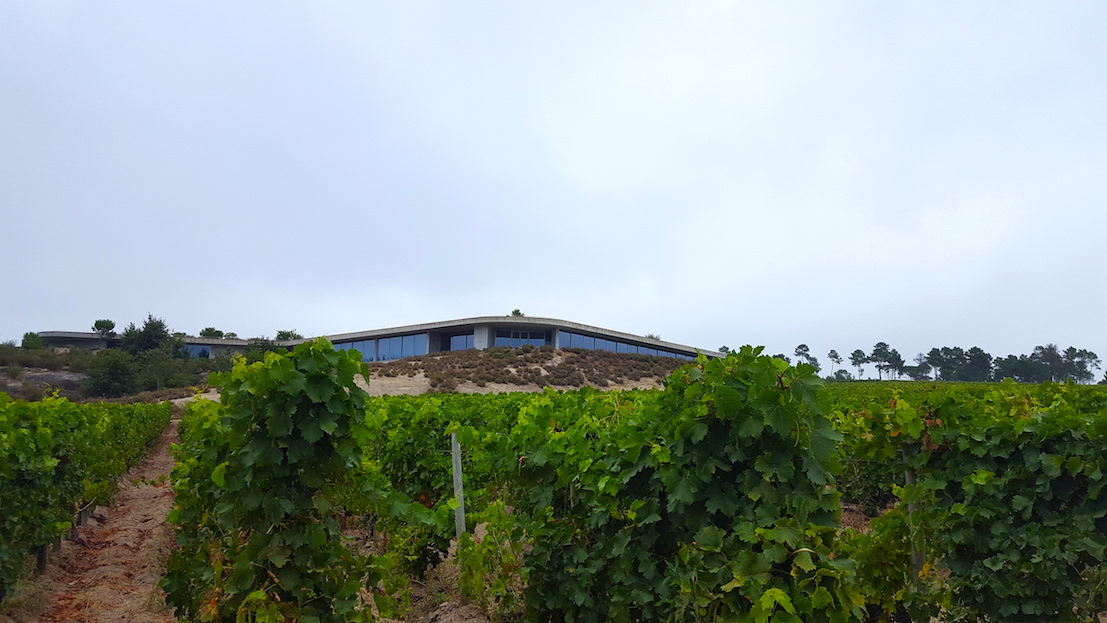
II. Quinta de Lemos: Geometric Minimalism in the Dão (Viseu)
Architecture and Vibe
If James Bond decided to retire and make wine, he would do it here. Quinta de Lemos is a manifesto of integrated modernity. The building, designed by architect Carvalho Araújo, appears to emerge directly from the region’s granite formations. It is a structure of exposed concrete and glass that embraces the natural rock, creating a visual dialogue between the ancestral and the contemporary. The vibe is one of icy sophistication that thaws the moment you touch its Nordic-inspired interiors.
The Wine Tourism Experience
“Quiet luxury” is the philosophy here. The visit begins in the vineyards, planted in monovarietal blocks that resemble a Zen garden. The descent into the cellar is a transition into perfect twilight, where silence is absolute. Tastings are held at a massive granite table under designer lamps that focus on the wine’s color with surgical precision.
The Star Wine: Dona Georgina
A red that pays homage to the family matriarch. It is a blend of Touriga Nacional and Tinta Roriz that has rested in new French oak. Its profile is one of Gothic elegance: notes of incense, wild berries, and a hint of dark cocoa. The tannins are so fine they feel like silk brushing the palate. It is, in essence, the bottled definition of sophistication.
The Wow Factor
Its restaurant, Mesa de Lemos (boasting a Michelin star). The cuisine is an ode to local produce elevated to stratospheric technical heights. But the secret detail is their own production of olive oil from millennial trees and the exclusive textiles that adorn every corner, reminding you that luxury is a complete tactile experience.


III. L’AND Vineyards: Sleeping Under the Stars (Alentejo)
Architecture and Vibe
Located near Montemor-o-Novo, L’AND is not just a winery; it is a spiritual retreat for the cosmopolitan elite. The complex, designed by Peter Märkli, is a minimalist interpretation of local monasteries. Clean lines, interior courtyards, and a masterful use of natural stone. The atmosphere is one of supernatural peace, where luxury manifests in space and light.
The Wine Tourism Experience
The experience here is holistic. You can participate in crafting your own wine under the supervision of the winemaker, learning the art of blending in a room that looks like a high-tech alchemist’s lab. Sunset tastings at the private lake club, watching the sun dip behind the Montemor castle, represent the peak of Alentejan hedonism.
The Star Wine: L’AND Reserva
A wine that captures the soul of the Alentejo but with an unusual freshness. Notes of black plum, licorice, and a subtle brushstroke of eucalyptus. It is an expansive wine that fills the mouth with warm generosity, finishing with a note of white pepper that invites another sip.
The Wow Factor
The Sky Suites. Rooms with roofs that retract completely at night, allowing you to sleep under Europe’s clearest starlit sky while a bottle of their finest vintage rests in an ice bucket by your bed. Literally, the sky is the limit.


IV. Casas do Côro: The Middle Ages with Wi-Fi and Grand Cru (Beira Interior)
Architecture and Vibe
In the historic village of Marialva, time stopped in the 12th century, but the amenities were updated to the 22nd. Casas do Côro is a project that has rehabilitated medieval granite houses into ultra-luxury refuges. It is a blend of meter-thick walls, roaring fireplaces, and Italian designer furniture. It is rustic, it is chic, it is utterly irresistible.
The Wine Tourism Experience
Here, wine is lived as part of the earth. The boutique winery is exclusive, producing “garage wines” of astonishing quality. The star experience is the nocturnal tasting in the “Eco-Winery,” where owner Paulo Romão guides you through his creations with infectious passion while an outdoor fire casts flickering shadows on the ancient stone walls.
The Star Wine: Casas do Côro “Branco de Curtimenta”
An orange wine crafted with ancestral techniques. It is an explosion of orange peel, dried fruits, and wilted flowers. In the mouth, it has the structure of a red and the freshness of a white. It is an intellectual wine, perfect for discussing philosophy or architecture by the fireplace.
The Wow Factor
The “Vinotherapy Spa.” Imagine soaking in a bath of grape extracts and mineral salts after a hike through castle ruins, followed by a massage with grape seed oil while sipping the house sparkling wine.


V. Vidago Palace: Belle Époque for the 21st Century (Trás-os-Montes)
Architecture and Vibe
Originally built as a summer residence for King Carlos I, Vidago Palace is the “Grand Budapest Hotel” of Portugal. It is a pink Belle Époque palace surrounded by centenarian parks and mineral water springs. Luxury here is classical: coffered ceilings, rock crystal chandeliers, and marble staircases that demand a gown or tuxedo to be descended.
The Wine Tourism Experience
While Vidago is not a winery per se, its subterranean cellar is one of the most comprehensive in the country. They organize private excursions to the most remote quintas of Trás-os-Montes, a region where vineyards grow at dizzying altitudes. Upon returning to the hotel, a private sommelier awaits you for a comparative tasting of the wines discovered during the day, paired with local cheeses not found in any commercial market.
The Star Wine: Quinta del Regueiro Reserva (High-altitude Alvarinho)
Although we are near the Spanish border, the Alvarinhos of Trás-os-Montes have a distinct personality. They are denser, more structured. Notes of white peach, salinity, and an electric acidity that cleanses the palate. It is the ultimate expression of mountain freshness.
The Wow Factor
The 18-hole golf course designed by Cameron & Powell is spectacular, but the true “wow” is the mineral water that flows from its springs. It is naturally effervescent and is said to have curative properties. Drinking a glass of Vidago water between glasses of wine is the connoisseur’s secret to avoiding a hangover and purifying the soul.

Pairing and Gastronomy: The Ritual of the Senses
In these regions, eating is an act of cultural resistance. Do not look for meaningless foams or pretentious spherifications; here, luxury is the product in its purest state.
In the Douro, the religious pairing par excellence is Cabrito Assado (roasted kid) in a wood-fired oven, its meat melting at the touch of a Reserva red. The animal’s fat merges with the wine’s tannins, creating a symphony of flavors that can only be described as an epiphany.
In the Alentejo, you must seek out Porco Preto (Iberian black pig fed on acorns). It is served simply grilled over coals with “migas” (fried bread with garlic and oil). Pair it with a powerful red and watch time stand still. And do not forget the cheeses. Queijo de Azeitão or Serra da Estrela—so creamy they are eaten with a spoon—are the sinful companions to any barrel-aged white wine. For a sweet finish, nothing beats the Ovos Moles of Aveiro, where egg yolk and sugar reach levels of almost alchemical perfection.
VIP Survival Guide: White-Glove Logistics
- Transport: Forget GPS and conventional rental cars. For this route, the ideal is to hire a private chauffeur with local knowledge or, better yet, travel by helicopter between estates. Quinta Nova and L’AND both feature private helipads.
- Reservations: In these temples of wine, improvisation is the enemy. Visits to private cellars and vineyard dinners should be booked at least three months in advance.
- Climate: The best time is September, during the harvest, to experience the energy of the crush. However, May offers a spring light that makes the vineyards look like liquid emeralds.
- Dress Code: “Country House Chic.” Linen, soft leather, and footwear that is comfortable yet elegant enough for walking through the vines.
Portugal is not a destination; it is a state of mind. It is the discovery that true exclusivity is not found on the price tag, but in the story told when uncorking a bottle in front of a landscape that has remained unchanged for centuries.