
The Awakening of a Liquid Giant: A Cinematic Introduction
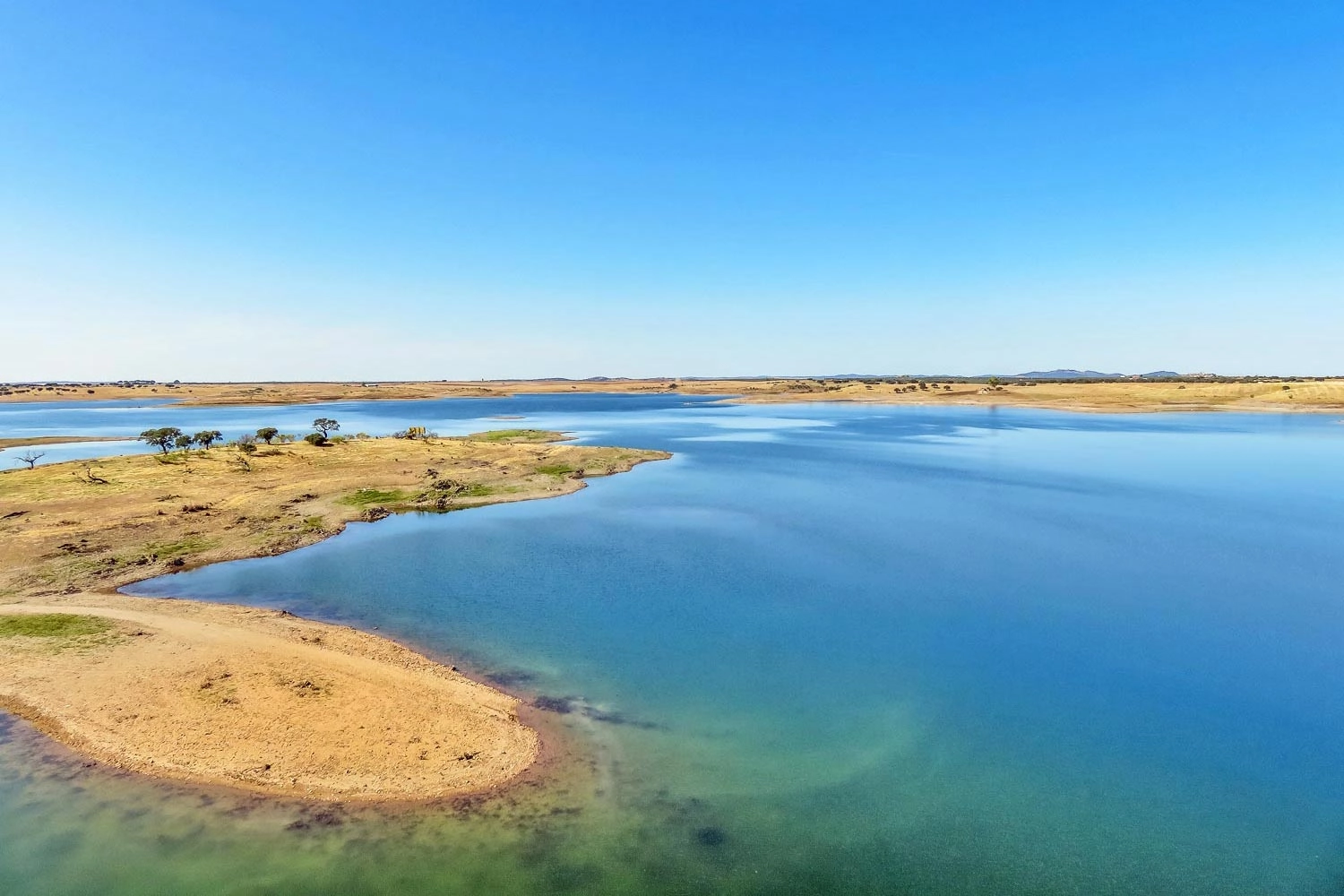
The Alentejo is not simply visited; it is inhaled. Imagine, for a moment, that the world has collectively decided to fall silent just for you. It is six in the morning, and the mist glides over the surface of the Great Lake of Alqueva like a silk veil over an ancient body. There are no engines, no intrusive smartphone notifications—only the rhythmic crunch of vine shoots beneath a viticulturist’s boots and the intoxicating aroma of wet earth—that petrichor which, in this corner of Portugal, smells of clay, schist, and the promise of bottled immortality.
We find ourselves in the heart of Europe’s largest artificial lake, but forget the engineering; the true feat here is the miracle of the vine defying the sun. The air is thick with the scent of rockrose and wild rosemary, a fragrance that we sommeliers call garrigue, which here infuses every cluster of Alicante Bouschet. As the first ray of sun dyes the lake’s waters a heretical orange, one realizes this is no mere stopover. This is the “Mecca” for the hedonist who has already tasted it all.
Navigating Alqueva is to glide across a mirror reflecting not just the clouds, but a history of resilience. Here, wine is not a commodity; it is the pulse of a people who learned to transform thirst into liquid poetry. If you seek the noisy ostentation of Saint-Tropez, you have taken a wrong turn. But if you seek the luxury of total disconnection, where the greatest concern is deciding whether that reserve red needs ten more minutes of decanting while you observe the clearest Milky Way of your life, then welcome to paradise. Prepare for a descent to the center of the earth and an ascent to the stars, all within the same glass.

The Soul of the Schist: Context and Terroir
To understand the wine of Alqueva, one must understand its geology, which is, in essence, a character straight out of a suspense novel. The Alentejo is a land of extremes, a stage where the sun punishes the earth with biblical severity during the summer. However, the creation of the great lake changed the script. This 250-square-kilometer mass of water now acts as a “thermal lung,” regulating nocturnal temperatures and allowing the grapes to breathe, ripening with an elegance that was once a Herculean challenge.
The soil is the true protagonist. Schist (slate) predominates—a laminar rock that forces the vine’s roots to drill through meters of stone to find a single drop of water. This agonizing struggle is what grants these wines their stinging minerality, that touch of “graphite” that separates a merely “correct” wine from a masterpiece. It is a terroir that demands respect; it does not forgive mediocrity.
The local varieties are the actors in this drama. Trincadeira, temperamental and difficult to cultivate, brings vibrant acidity and notes of black plum. Aragonez (our beloved Tempranillo, but with a more robust Portuguese accent) provides the structure. But the undisputed queen of the region is Alicante Bouschet. Though of French origin, it has found its true motherland in the Alentejo, producing wines of a color so deep they resemble squid ink, with an aging capacity that defies time itself. Here, the wine has “grip”; it has broad shoulders, yet once in the glass, it reveals itself with the sophistication of a bespoke tuxedo.
Temples of Wine: A Detailed Analysis of Elite Estates
Navigating Alqueva allows for access to the private docks of some of the most exclusive properties on the Iberian Peninsula. These are not merely wineries; they are sanctuaries where architecture and oenology dance a tango of precision.
Architecture and Vibe Arriving at Esporão is like stepping onto the set of a minimalist architectural film. Its iconic medieval tower, the Torre do Esporão, stands guard over a sea of vineyards that look as though they were combed by a giant. The main winery is an exercise in modern sobriety: exposed concrete, pure lines, and an organic integration with the landscape. It is the perfect equilibrium between 13th-century heritage and 21st-century vision.
The Wine Tourism Experience Here, luxury is felt in the silence. The private tour begins with a stroll through their ampelographic gardens, where they preserve nearly extinct varieties. However, the climax occurs in the barrel cellar: a cathedral-like space where thousands of liters of wine rest under dim light. The sound of the cork popping on a Private Selection in their glass-walled tasting room, overlooking the sunset over the reservoir, is an almost religious experience. One feels the weight of history in every corner, yet with the freshness of a management that embraces organic practices with fervor.
The Star Wine: Esporão Private Selection Red This wine is liquid velvet. In a vertical tasting, one perceives its evolution: from intense notes of black fruit and mocha in its youth to nuances of tobacco, fine leather, and a hint of licorice after ten years in the bottle. It possesses a kilometric finish that forces you to close your eyes to process the complexity of its tannins, polished like river stones by an eternal stream.
The Wow Factor: Their private art collection. Every year, a renowned artist designs the labels for their primary wines. To own a vertical of Esporão is, quite literally, to own an art gallery in your personal cellar. Furthermore, their extra virgin olive oil is arguably the best in the world; requesting a technical oil tasting before the wine will change your palate forever.
Architecture and Vibe Ervideira possesses that charm of a boutique winery that has decided to break all the rules. Its design is functional, welcoming, and exudes the energy of an “idea laboratory.” Do not look for Carrara marble here; look for the warmth of a family that has been obsessed with excellence for four generations.
The Wine Tourism Experience Have you ever tasted a wine that has aged at the bottom of a lake? Ervideira offers the opportunity to sail to the exact point where they submerge their bottles at a depth of 30 meters. The visual descent through their storytelling, while you hold a bottle covered in small marine encrustations, is fascinating. The constant pressure and stable temperature of the Alqueva floor accelerate the aging process in a way that science is still trying to fully explain.
The Star Wine: Conde d’Ervideira Vinho da Água This is a wine that defies logic. On the nose, it is an explosion of ripe red fruits, but on the palate, it possesses a roundness and smoothness that only the “embrace of the lake” can bestow. It is a wine with a “diver’s soul”: deep, mysterious, and with a subtle salinity that makes you salivate for the next sip.
The Wow Factor: The “Invisível” (Invisible) wine. A white wine crafted from red grapes (Aragonez), where the must is extracted with such delicacy that it carries no color from the skins. It is the best-kept secret of local sommeliers: a wine that smells of rose petals and lychee but possesses the structure of a red. An oenological magic trick.
Architecture and Vibe Situated on the banks of the Guadiana River, just where it feeds the Alqueva, Sobroso is an exotic blend of a Portuguese estate and an African lodge. Its Mudéjar-style architecture, with high ceilings and interior courtyards, invites aristocratic languor. It is the ideal refuge for those seeking absolute privacy.
The Wine Tourism Experience The experience here is dynamic. Forget static tasting rooms. At Sobroso, you board a 4×4 Jeep for a “safari” through the vineyards, where it is common to cross paths with fallow deer, wild boar, and mouflons. Following the tour, the tasting takes place in a private gazebo by the water’s edge, where the only sound is the splashing of fish and the whisper of the wind through the cork oaks.
The Star Wine: Arché This is their flagship “author wine,” an ode to sophistication. It is a blend that showcases the power of the terroir but with surprising freshness. Notes of graphite, “sunrise” (that metallic freshness of the morning), and a wood integration that feels like a caress. It is a cerebral wine, meant to be unraveled slowly.
The Wow Factor: Access by air and water. You can arrive in your own yacht from the center of the lake or land a helicopter directly on the property. But the true “wow” is their private dinner under the stars: Alqueva is a Starlight reserve, and dining among the vines with a professional telescope by your side while an astronomer explains the mythology of the constellations above is an experience that redefines the concept of luxury.

Food Pairing and Gastronomy: A Religious Communion
In the Alentejo, eating is an act of cultural resistance. The gastronomy here is not “fusion”; it is brutal honesty elevated to the category of art. To make your Alqueva experience complete, you must surrender to the Porco Preto (Black Iberian Pig). It is a meat that melts on the tongue, with an infiltration of fat that is pure cardiovascular gold.
Imagine pairing a potent Alicante Bouschet red with a Pluma Ibérica over the coals, seasoned only with sea salt crystals and a touch of cilantro. The fat of the pork softens the wine’s tannins, while the wine’s acidity cleanses the palate for the next bite. It is a perfect circle.
We cannot forget the Açorda, a soup of bread, garlic, olive oil, and cilantro which, when accompanied by poached eggs and fresh river prawns, creates an incredible contrast of textures. And, of course, the cheeses. The Queijo de Évora (cured sheep’s cheese, sharp and spicy) requires a wine with body—preferably a barrel-fermented white that can hold its own in a duel of flavors. Desserts such as Encharcada (a feast of egg yolks and sugar) cry out for a local dessert wine, closing the cycle of a dinner that is not a meal, but a liturgy.
VIP Survival Guide: Exclusivity in the Alentejo
For the traveler who accepts nothing less than the extraordinary, here are the golden rules:
Navigating Alqueva is, ultimately, a journey toward one’s inner self, guided by the light of the stars and the glint of a fine crystal glass. It is a place where time bends and where luxury is measured in the quality of the silences and the depth of the flavors.






Don't just get there, get there in style.
Information
Follow Us
Payment channels


